
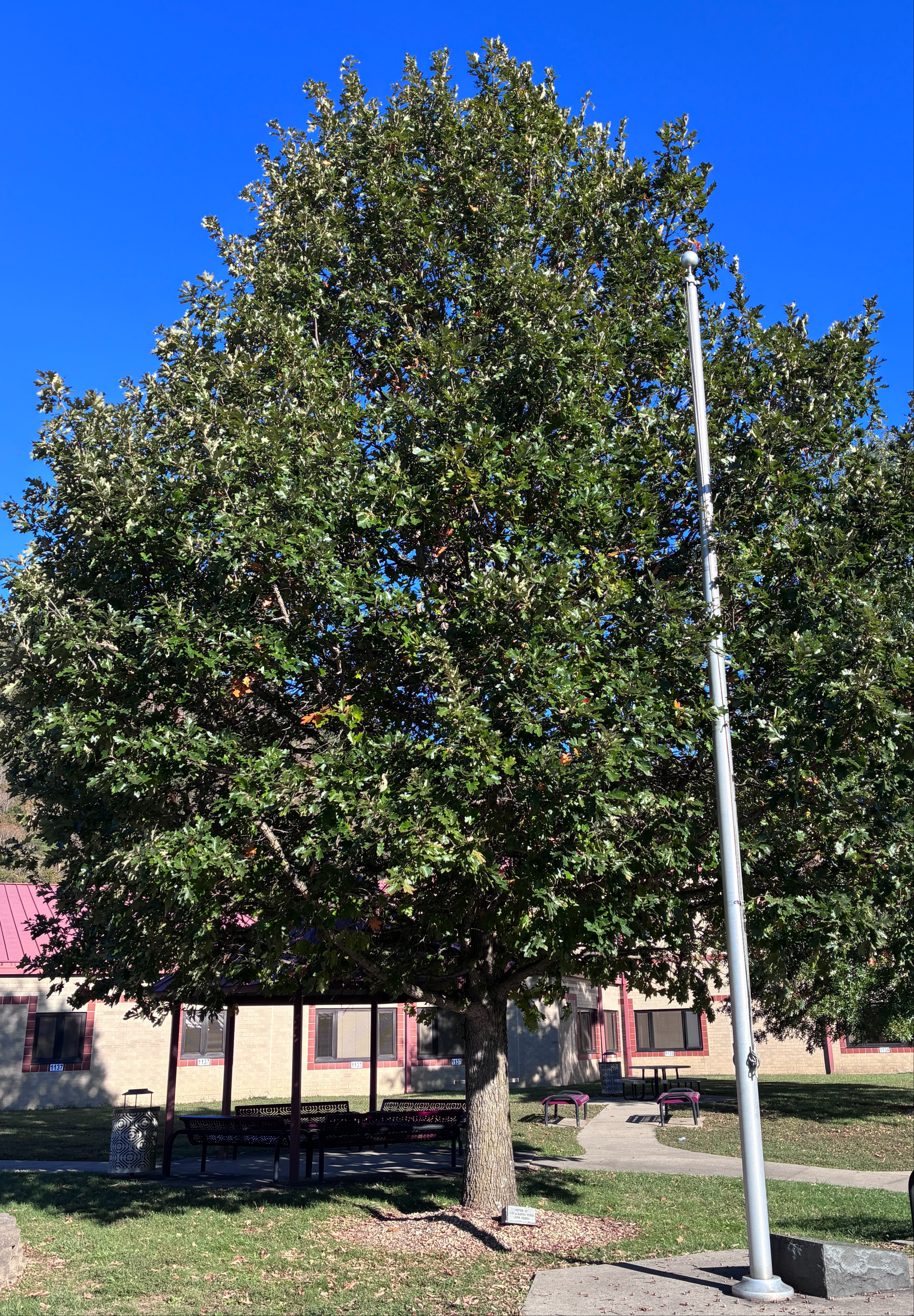
Photo Credits: Dr. Loretta W. Harvey
Scientific Name: Quercus alba
Common Name: White Oak or American White Oak
Type: Deciduous Hardwood
Family: Fagaceae (Beech/Oak family)
Native Range: Eastern and Central North America
USDA Zone: 3-9
Height: 60-100 feet
Spread: 50-90 feet
Bloom Time: April-May
Bloom Description: Male flowers are inconspicuous, yellowish-green, slender, drooping catkins (2-4 inches long). Female flowers are small, reddish spikes near the tips of new growth. Wind-pollinated.
Sun: Full sun
Water: Medium; prefers deep, moist, well-drained, acidic soil but is quite drought-tolerant once established.
Maintenance: Low. Requires little pruning beyond removing dead or diseased wood. Sensitive to root disturbance and soil compaction, making it difficult to transplant successfully, especially when large.
Leaf Type/Shape: Simple, lobed, deciduous. 5 to 9 inches long with 7 to 9 rounded (not bristle-tipped) lobes separated by deep sinuses. Bright green above, paler beneath. Turns a distinctive red-brown, burgundy, or wine-red in the fall, with some dry leaves often persisting through winter (marcescence).
Attracts: Keystone species for wildlife. Acorns are a vital food source for white-tailed deer, wild turkeys, squirrels, chipmunks, and many birds (blue jays, woodpeckers). Larval host for hundreds of species of butterflies and moths.
Other Info: Known for its longevity; can live for several hundred years. The wood contains structures called tyloses which prevent liquid flow, a trait critical for its use in cooperage (barrel making).
Tolerate: Drought (once established), moderately tolerant of clay soil, and deer browse (high tolerance).
Invasive: No
Climate: Thrives in a wide range of climates across the Eastern US, from cold northern winters to hotter southern summers. It performs best in regions with ample rainfall and well-defined seasons.
Noteworthy Characteristics: Light gray to nearly white, giving it the common name. The bark is shaggy or scaly, breaking into irregular, vertical plates or shallow furrows on mature trees. Acorns mature in a single season; acorns are oblong, 1/2 to 1 inch long, and relatively sweet (low in tannin), making them a preferred wildlife food. Acorn production is cyclical, with large crops ("mast years") occurring every few years. Develops a broad, round, majestic canopy with large, often nearly horizontal lower limbs, making it an excellent shade tree for large parks and properties. White oak wood is highly valued for its strength, weight, and unique water-tight properties.
Problems: Transplanting Difficulty: Due to a strong taproot and sensitivity to root disturbance, it is notoriously difficult to transplant successfully once it has grown beyond a small sapling size. Slow Growth: Generally slow to moderate growing, making it less popular in landscapes where quick growth is desired. Pests/Diseases: Susceptible to several issues, including:1) Oak Wilt: A serious, often lethal fungal disease, though White Oaks are more resistant and slower to succumb than Red Oaks; 2) Gypsy/Spongy Moth: Larvae can defoliate trees; 3) Galls: Various gall-forming insects can be abundant on leaves and twigs; 4) Fungi including Anthracnose and Powdery Mildew on the foliage.
Economic Uses: Lumber: One of the most commercially important hardwoods. The wood is extremely strong, heavy, hard, and rot-resistant. Cooperage (Barrel Making): The key economic use. Due to the tyloses (internal blockages in the wood vessels), the lumber is impervious to liquids, making it essential for aging whiskey, bourbon, and wine barrels. Flooring, Furniture, and Veneer: Prized for its beautiful grain, durability, and strength in interior applications. Firewood: Excellent, high-density firewood with a high heat value.
Donated by: Lana Perry
In honor of: Jean & Buddy Perry
Arboretum Catalog Number: 0019
Photo Credits: Dr. Loretta W. Harvey