
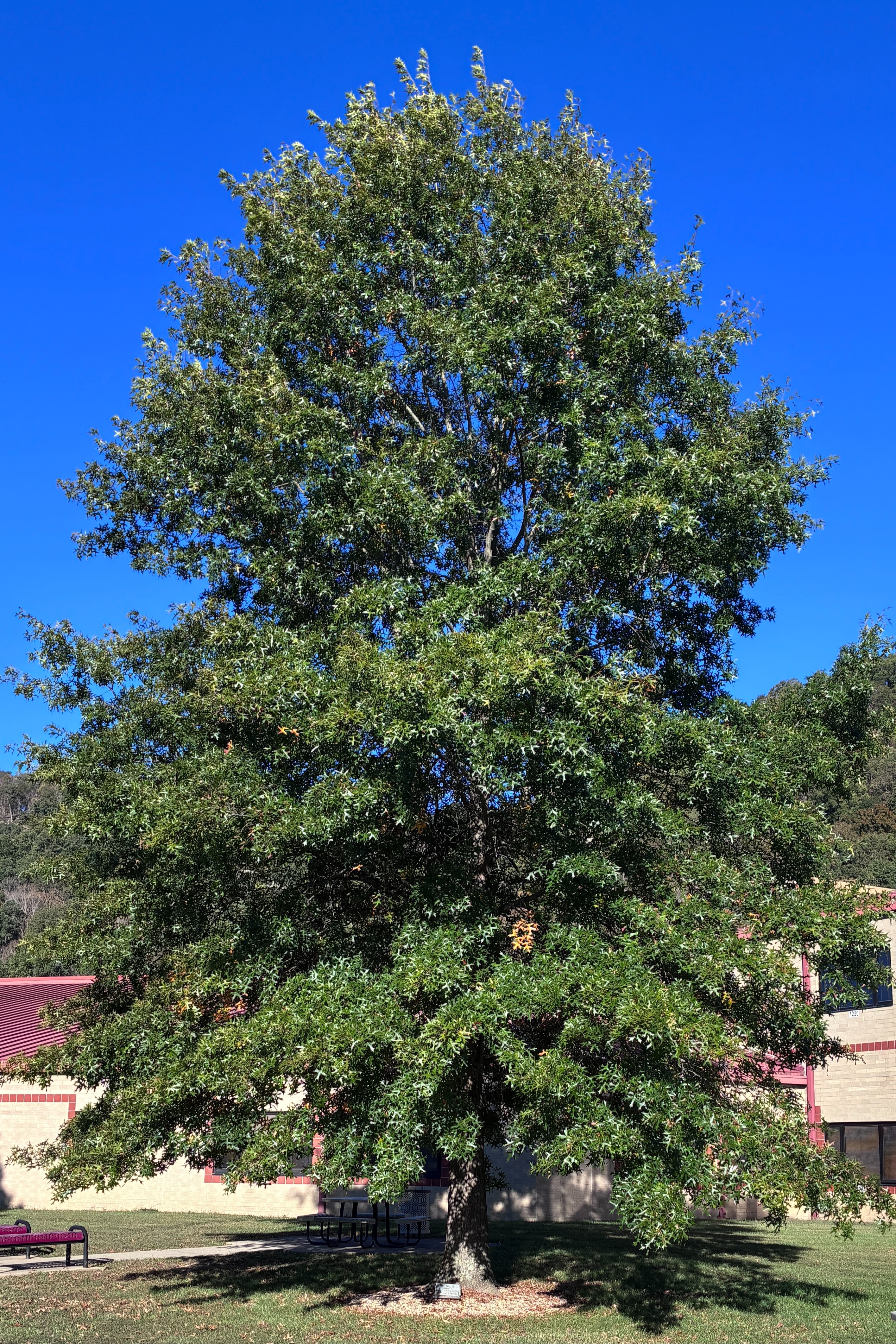
Photo Credits: Dr. Loretta W. Harvey
Scientific Name: Quercus palustris
Common Name: Pin Oak
Type: Deciduous
Family: Fagaceae (Beech family)
Native Range: Eastern and Central North America
USDA Zone: 4–8
Height: 60–70 feet
Spread: 40–60 feet
Bloom Time: April–May
Bloom Description: Inconspicuous; male flowers are yellow-green catkins, female flowers are small, red spikes
Sun: Full Sun
Water: Prefers moist, acidic, well-drained soils
Maintenance: Moderate; requires occasional pruning to manage lower branches, iron deficiency in high-pH soils
Leaf Type/Shape: Lobed; deep sinuses create 5-7 pointed, bristle-tipped lobes. Glossy dark green in summer, turning russet, bronze, or dull red in fall.
Attracts: Squirrels and various wildlife (acorns); pollinators (early spring catkins)
Other Info: Known for its distinctive pyramidal to oval crown when young, maturing to a more open, rounded canopy. Named for the short, sharp, "pin-like" branchlets that occur along the branches.
Tolerate: Wet soil conditions (palustris, meaning "of the marsh"), air pollution, and soil compaction.
Invasive: No
Climate:Temperate, thrives in areas with cold winters and warm summers.
Noteworthy Characteristics: A defining feature is the tiered branching pattern. Upper branches ascend, middle branches extend horizontally, and lower branches droop downward. Among the faster-growing oaks, which makes it popular for quick shade and street planting. Small, rounded acorns (about 1/2 inch long), borne in a thin, shallow cup, providing a good food source for wildlife.Though sometimes inconsistent, it can provide a good show of red-bronze to deep red foliage, often holding leaves late into winter.
Problems: The Pin Oak is highly susceptible to iron chlorosis (yellowing of leaves between the veins) when planted in alkaline (high-pH) soils. This is its most common and serious issue in many urban settings outside its native, acidic range. The strong tendency for lower branches to remain on the trunk and droop can require significant maintenance pruning to allow clearance for pedestrians or vehicles. Susceptible to gall wasps and certain borers, though generally not fatal.
Economic Uses: Extensively used as a shade tree, street tree, and for large parks and institutional grounds due to its tolerance of urban conditions and relatively fast growth. The wood is hard and heavy, similar to other red oaks, but less frequently used commercially due to the large number of knots (pins) that result from the persistent small branchlets. If used, the wood is for general construction, low-grade lumber, or firewood.
Donated by: Elmo Smalley
In honor of: George Jenkins & Margaret Parry
Arboretum Catalog Number: 0015-B
Photo Credits: Dr. Loretta W. Harvey